
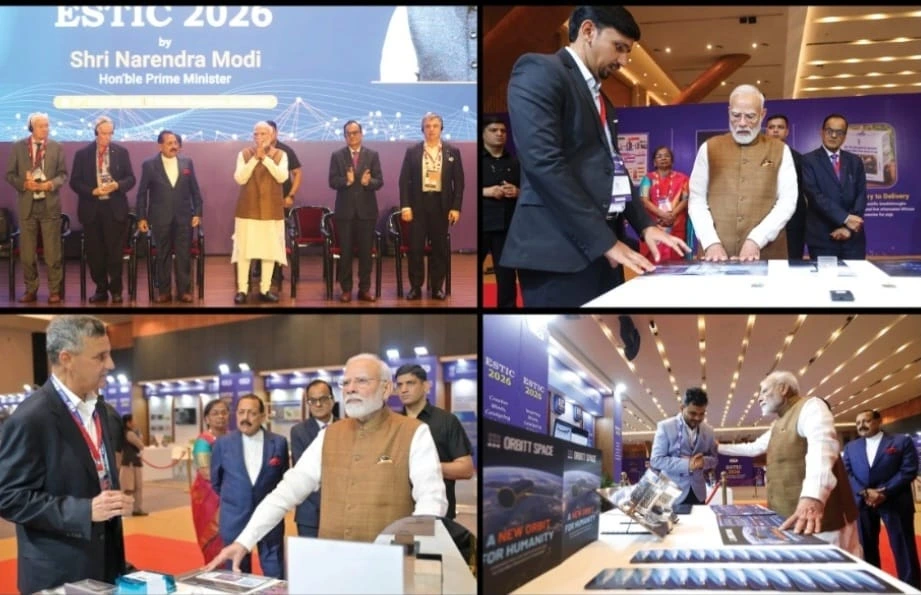
Prime Minister Narendra Modi on Tuesday urged India’s scientists, researchers and young innovators to develop technologies that solve real-world problems, strengthen the country’s self-reliance and benefit humanity, calling for measurable results over the next three years.
Addressing the Emerging Science, Technology and Innovation Conclave (ESTIC) 2026 in New Delhi, Modi said India had moved beyond an era when it largely followed technological advances made elsewhere and was now aiming to create new technologies and solutions to global challenges.
Modi said India had moved beyond an era when it largely followed technological advances made elsewhere and was now aiming to create new technologies and solutions to global challenges.
Held at Bharat Mandapam from October 27 to 29, ESTIC brings together scientists, policymakers, businesses, start-ups and young researchers. Its 12 thematic areas include artificial intelligence, biotechnology, semiconductors, energy, healthcare and space science.
The conclave aims to strengthen collaboration between research and industry, helping turn scientific discoveries into practical solutions. Its theme is “Creative Minds, Catalysing Science, Empowering Technologies.”
Modi cited India’s response to the COVID-19 pandemic as an example of what innovation should be.
He recalled when India developed its own vaccines, conducted a large-scale vaccination drive and supplied vaccines to other countries, as an example of this changing approach.
“Science is successful when something from a lab improves everyday human life,” he said, stressing that scientific progress should be judged by the problems it solves and the number of lives it changes, rather than how advanced a technology is.
Modi highlighted India’s achievements in space exploration, nuclear technology and artificial intelligence as examples of its growing scientific capabilities.
He recalled India’s Mars mission, which succeeded on its first attempt, and the Chandrayaan-3 mission, which made India the first country to land near the Moon’s South Pole.