
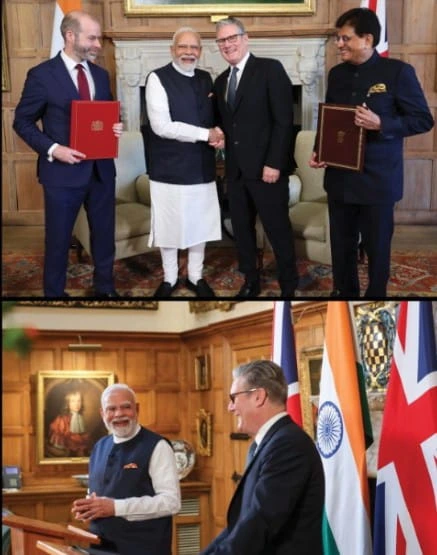
INDIA HAS secured market access for key job-creating sectors such as textiles, footwear, gems and jewellery, and marine products — where the UK is set to eliminate duties of up to 20 per cent.
Negotiators have also managed to push for eliminating duties for almost 99.7% of tariff lines in India’s food sector. In most food items, the tariffs were as high as 70 per cent. New Delhi extracted enhanced market access in export-oriented sectors such as marine and animal products, including seafood, dairy, and meat products, with tariffs reduced to zero from up to 20 per cent.
On its part, New Delhi has allowed British companies to participate in a class of public procurement tenders, and also opened the highly-tariffed automobile and alcoholic beverage industries.
The UK government said its large and varied manufacturing sectors will benefit from tariff cuts on aerospace (reduced from as high as 11% to 0%), automotives (from up to 110% down to 10%), and electrical machinery (from up to 22%).
For the first time, India has allowed duty cuts for UK-origin alcohol including whisky, brandy, rum, vodka, liqueurs, mead, cider, and tequila. These products, which currently face a base customs duty of 150 per cent, will see steep reductions — but only if they meet a Minimum Import Price (MIP) threshold of $5 per litre or $6 per 750 ml bottle. For qualifying imports, the duty will be gradually lowered from 110 per cent in Year 1 to 75 per cent by Year 10, through equal annual reductions.
In a first, India has allowed UK firms to participate in government tenders, offering them Class Two status under ‘Make in India’ rules, which require 20-50 per cent domestic value addition. While India had previously opened public procurement under the UAE deal, experts said the deal offered to the UK is the most generous yet.
This is the most extensive concession in government procurement that India has offered in any FTA to date and marks a strategic shift away from using public procurement as a tool for domestic industrial development.